Free Weights vs Machines for Muscle Activation: What Science Actually Shows
The debate between free weights and machines has dominated gym floors for decades. But here’s what matters: recent research shows comparable regional hypertrophy of knee extensor muscles in response to resistance training with machines versus free weights. The truth is more nuanced than “free weights are always better.” Let’s break down the science.
Muscle Hypertrophy: Both Deliver When You Train Hard
The most important finding for muscle-building: machines and free weights produce comparable muscle hypertrophy when training load is matched. A randomized within-subject study directly compared both modalities and found no significant difference in muscle growth across regions.
What does this mean for you? Stop wasting mental energy on the debate. If you’re training hard, eating enough protein, and progressively overloading—both methods work. The best tool is the one you’ll use consistently and load progressively.
Stabilizer Muscle Activation: Where Free Weights Shine
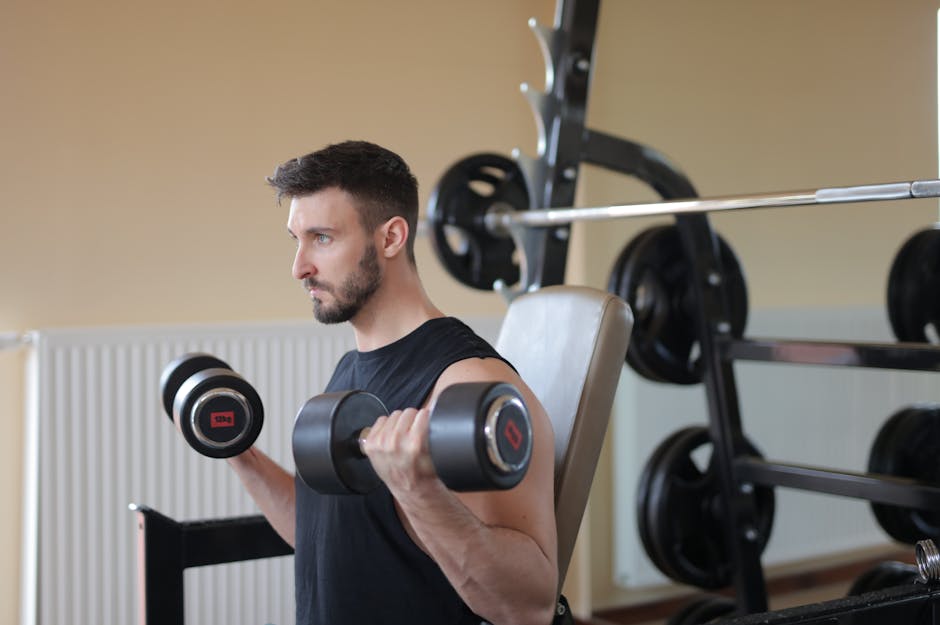
While total hypertrophy is equal, free weights demand more from stabilizer muscles. Dumbbells and barbells force your core, smaller synergistic muscles, and stabilizer chains to work harder than guided machine movements.
This translates to:
- Greater core activation
- Improved inter-muscular coordination
- Better real-world functional strength
- Enhanced proprioceptive adaptation
For pure muscle growth, the difference is negligible. For athletic performance and total body development, free weights maintain an edge.
Perceived Exertion and Training Load Tolerance
Research on training load shows that affect and perceived exertion increase with higher training intensity. This matters because perceived difficulty influences exercise selection and adherence.
Machines typically feel “easier” because they stabilize the load. Free weights feel harder due to stabilization demands. Neither is inherently better—it depends on your goals:
- Maximize muscle damage quickly: Free weights
- High volume, minimal CNS fatigue: Machines
- Deload weeks/injury recovery: Machines
Functional Strength Transfer: The Real Difference
Studies comparing seated machine training to standing cable training show better improvements in physical function with standing movements. This suggests that movements requiring stabilization and coordinated whole-body effort transfer better to real-world strength.
Translation: If your goal is pure muscle size, machines work fine. If you want strength that transfers to athletic performance, free weights create superior functional adaptations.
Equipment Matters More Than You Think for Accuracy
Research on repetitions in reserve shows that the type of exercise equipment affects your ability to accurately assess proximity to failure. This impacts training precision and recovery management.
With free weights, you develop better intuition for failure. Machines provide more consistent resistance curves, making RPE assessment slightly more reliable—but at the cost of reduced sensorimotor feedback.
The Practical Recommendation: Use Both
Here’s the alpha move: stop choosing. The science supports a mixed approach:
- Compound Movements (Squat, Bench, Deadlift): Free weights. Build stabilizer strength, CNS adaptation, and maximum tension.
- Isolation Exercises: Machines shine. Higher volume, less joint stress, easier to accumulate reps.
- Weak Points/Hypertrophy Focus: Hybrid approach. Start with free weights for strength work, finish with machines for volume.
- Deload/Recovery Weeks: Machines reduce neural fatigue while maintaining mechanical tension.
Sample structure:
- Compound free weight lift (3-5 sets, 3-6 reps)
- Secondary free weight variation (4 sets, 6-8 reps)
- Machine isolation work (3-4 sets, 8-12 reps)
Bottom Line
The science is clear: free weights and machines both build muscle when you train hard. Free weights provide superior stabilizer activation and functional strength transfer. Machines allow higher volume with less systemic fatigue. The optimal approach integrates both.
Stop debating. Start lifting. Progress comes from consistency, progressive overload, and eating enough—not from choosing the “perfect” modality.
Take Action Today
Audit your current training split. If you’re 80% machines, add free weight compounds to your main lifts. If you’re all barbell, incorporate 2-3 machine exercises per session for volume efficiency. Track your strength and growth for 8 weeks. Data beats opinion.
Train hard. Eat big. Get big.
Scientific References
-
Amanuma, Ikeda, Sakamoto et al. (2025).
Comparable regional hypertrophy of the knee extensor muscles in response to resistance training with machines versus free weights: a randomized within-subject approach..
Journal of bodywork and movement therapies.
View on PubMed → -
Rosa, Zia, Inan et al. (2021).
Machine learning to extract muscle fascicle length changes from dynamic ultrasound images in real-time..
PloS one.
View on PubMed → -
Cavarretta, Hall, Bixby et al. (2022).
The Effects of Increasing Training Load on Affect and Perceived Exertion..
Journal of strength and conditioning research.
View on PubMed → -
Balachandran, Martins, De Faveri et al. (2016).
Functional strength training: Seated machine vs standing cable training to improve physical function in elderly..
Experimental gerontology.
View on PubMed → -
Ruiz-Alias, Baena-Raya, Hernández-Martínez et al. (2025).
Estimating Repetitions in Reserve During the Bench Press Exercise: Should We Consider Sex and the Exercise Equipment?.
Sports health.
View on PubMed →