Resistance Training Equipment Selection Guide: Science-Backed Choices for Maximum Muscle Gains
Your equipment choices directly impact muscle hypertrophy, strength gains, and injury risk. Most lifters make poor selections early on, wasting months of training without optimal results. This guide cuts through the noise and gives you the exact framework for selecting equipment that maximizes gains while protecting your joints for long-term progression.
Understanding Joint Health and Training Equipment
Before selecting equipment, understand what’s happening in your joints during resistance training. Research on joint mechanics shows that proper equipment selection and technique are critical for maintaining joint function during repetitive stress activities. Your knees, shoulders, elbows, and hips take constant load during training—choosing wrong equipment accelerates degeneration.
The equipment you choose determines movement patterns. Free weights demand stabilizer muscle recruitment. Machines provide fixed paths. Cables offer variable resistance. Each has distinct applications for your training block. Your selection should be intentional, not random.
Free Weights vs. Machines: Which Delivers Superior Results?
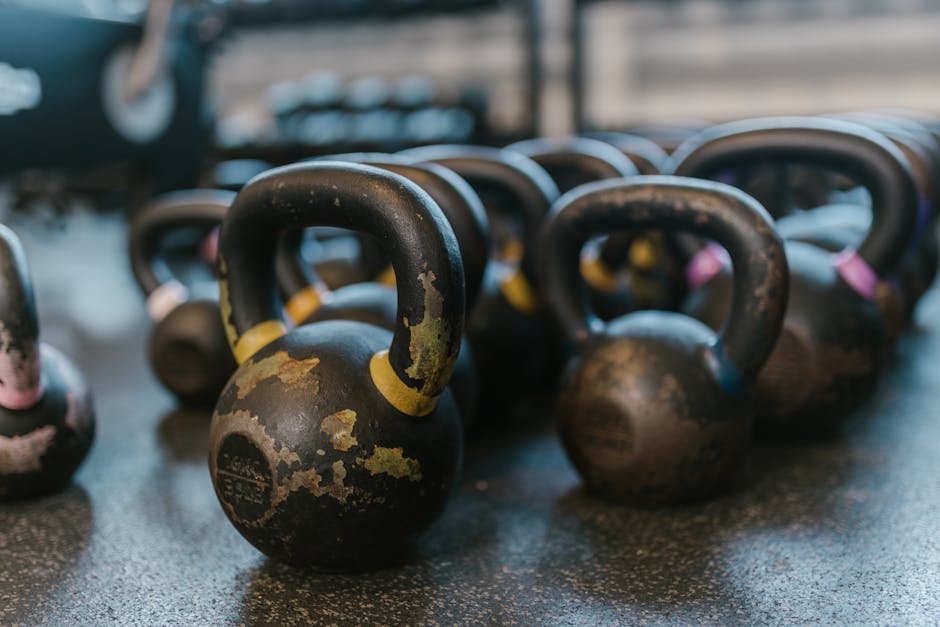
Free weights build functional strength and activate stabilizer muscles at higher rates than machines. Barbells, dumbbells, and kettlebells force your nervous system to recruit more motor units, translating to greater strength development and muscle activation patterns that transfer to real-world movements.
However, machines aren’t inferior—they’re situational. Machines excel at:
- Isolating specific muscle groups when stabilizers are fatigued
- Protecting joints when you’re pushing heavy loads on compound lifts
- Providing consistent resistance curves for muscle hypertrophy
- Reducing injury risk during deload phases
Evidence supports progressive resistance training as a fundamental strategy for maintaining musculoskeletal function and quality of life across training phases. The best lifters strategically layer both.
Action Step: Build your primary lifts (squat, bench, deadlift, row) around barbells and dumbbells. Use machines for isolation work and joint-friendly accessories during high-volume training blocks.
The Equipment Hierarchy for Maximum Hypertrophy
Tier 1 (Non-Negotiable):
- Power rack with safety bars
- Competition barbell (20kg, IPF-certified)
- Adjustable dumbbells (5-50+ lbs)
- Flat and incline benches
Tier 2 (High ROI):
- Cable machine or functional trainer
- Leg press or v-squat machine
- Plate-loaded machines
- Resistance bands (heavy-duty)
Tier 3 (Complementary):
- Kettlebells
- Medicine balls
- Trap bar
- Specialty bars (safety bar, cambered bar)
Start with Tier 1. This covers 85% of hypertrophy work. Add Tier 2 when you have a solid foundation and higher training volume. Tier 3 items solve specific problems (weak points, injury prevention, conditioning).
Injury Prevention Through Smart Equipment Selection
Joint integrity determines training longevity. Research continues to reveal new mechanisms in how repetitive stress impacts tissues and movement patterns over extended training careers. Equipment choice directly influences these stress patterns.
Shoulder Health: Use dumbbells instead of barbells for pressing when shoulder position feels compromised. Machines lock you into fixed ranges of motion, reducing unstable positions that cause impingement.
Knee Health: Leg press machines reduce shear force on knee joints compared to barbell back squats during max-effort work. Rotate between free weight and machine leg training within the same microcycle.
Lower Back: Smith machines reduce spinal shear during heavy deadlifts. Trap bars reduce lordotic stress compared to conventional barbells. Use strategically during high-intensity phases.
Elbow Health: Cable machines provide smoother resistance curves than dumbbells for isolation work. This reduces joint stress on triceps and biceps during high-rep accessory work.
Action Step: Map your weak points. If shoulders hurt on barbell pressing, switch to dumbbells or machines for 4-8 weeks. Reintroduce barbells with reduced volume once pain resolves.
Budget-Smart Equipment Progression for Serious Lifters
You don’t need everything at once. Build systematically.
Phase 1 ($500-800): Power rack, barbell, 300 lbs of plates, adjustable dumbbells. This is sufficient for 2+ years of solid hypertrophy work.
Phase 2 ($1,200-1,800): Add adjustable bench, cable machine or resistance bands, plate-loaded leg press.
Phase 3 ($2,000+): Specialty bars, dedicated machines, premium barbells, high-end dumbbells (100+ lbs).
Don’t chase equipment. Chase progressive overload with what you have. A lifter with a barbell and dumbbells consistently outperforms a lifter with $10,000 in equipment using poor programming.
Bottom Line
Equipment selection isn’t about having the newest machines—it’s about strategic choices that maximize hypertrophy, strength, and joint longevity. Prioritize barbell and dumbbell work for your compound lifts. Layer machines and cables for accessories. Rotate equipment when joints need deloading. Build progression gradually over months and years.
Your training career spans decades. Equipment choices compound. Choose wisely.
Start by auditing your current setup. What’s missing from Tier 1? Invest there first. Tag us when you make your upgrades—let’s see what equipment delivers results for your training.
Scientific References
-
Sexton, Bitan, Bowles et al. (2024).
Novel avenues of tau research..
Alzheimer’s & dementia : the journal of the Alzheimer’s Association.
View on PubMed → -
Harris, Oni et al. (2024).
Cementless, Cruciate-Retaining Primary Total Knee Arthroplasty Using Conventional Instrumentation: Technical Pearls and Intraoperative Considerations..
JBJS essential surgical techniques.
View on PubMed → -
Blumstein, Gorevic et al. (2005).
Rheumatologic illnesses: treatment strategies for older adults..
Geriatrics.
View on PubMed → -
Wang, Wu, Zhang et al. (2025).
Barriers and facilitators to implementing pelvic floor muscle training after radical prostatectomy in China: a qualitative study using the consolidated framework for implementation research..
Supportive care in cancer : official journal of the Multinational Association of Supportive Care in Cancer.
View on PubMed →